

This track includes ten minutes of meditation practice; if that feels like a lot to you, maybe start at the beginning
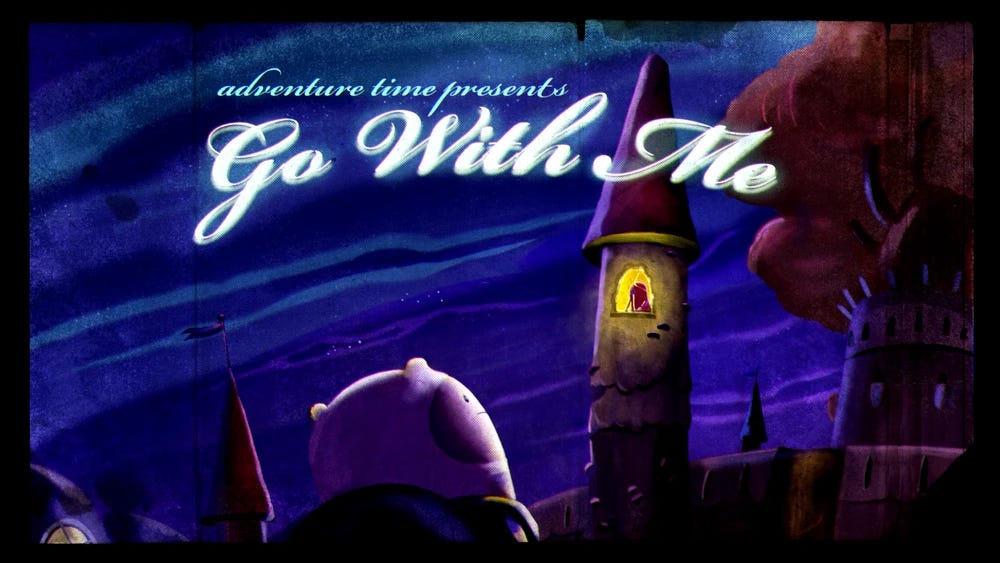
Turn on the TV, get comfy, and play this track after you’ve watched the episode: Go With Me (Season Two, Episode Twenty).
Mentioned in this track is Devon Price’s piece: An Autistic Social Butterfly’s Guide to Making Friends
P.S. If you’re curious, here you can find out why I started this project.
Recording Transcript (Meditation Begins at 4:33)
Hello again adventurer!
It is good to be with you. And I hope you are “busy practicing for the Whistling Choir Death Match Championship.” Otherwise, ya know, you might die cuz your whistling sucks.
But you can take a break from whistling practice for now so that we can practice meditating together. Specifically, so we can practice mediating around a sense of care in our lives.
Sometimes the people who care about us advise us to do things that make us act like a psycho and get kicked out of the Candy Kingdom. I suppose that’s one of the situational hazards of having friends; they can be prone to giving bad advice. Their sense of care can be misplaced, and if you don’t have an anchored sense of your own self, then you’re gonna maybe find yourself donning the lute suit and “romancin’ it up all day” when you really just wanna go to the movies.
In Finn’s case, an extra layer of complexity seems to be an inability to understand social norms, as well as gender roles. So when Jake tells him that you “have to bring somebody you can smooch” to Couple’s Night, even though he doesn’t want to, Finn believes him. And social norms are deeply powerful, even though they are mostly unspoken and implicit. “It’s like the rules.”
As an autistic, transfemme person myself, I can really relate to Finn’s genuine confusion at why he can’t just go to the movies, and why doing so should require him to woo Princess Bubblegum as someone he “can kiss.” Thankfully, learning about autism helped me understand the physical and psychological toll of constantly abiding by social norms, even when I don’t understand them or agree with them. Which created a lot of freedom in my life. Now I can just go to the movies by myself on couple’s night if I want to.
And I’m not necessarily suggesting that Finn is autistic (but I’m also not suggesting he isn’t; that’s really not mine to decide and it doesn’t particularly matter to me either way), but I think that most of us, autistic or not, can find a greater sense of peace and comfort when we assess social norms for what they are, and the extent to which they feel true, relevant, and desirable in our lives, instead of just accepting them because “it’s like the rules.”
And I think that Finn would’ve been better off following along with this piece of advice from Devon Price, which I resonate with a lot:
“Far too often, neurodivergent people exclude ourselves from social settings because the pain of conforming to neurotypical standards is so profound. This just leaves us more isolated. Showing up as your real self (and honoring your real feelings) is the remedy.”
And if you find yourself in a place where you don’t feel like you have, or know how to make, friends that like you for who you are, rather than for how much you adhere to social norms, then you might enjoy Devon’s article.
For many of us, unlearning systems of ableism, and holding social norms more loosely, is a process of “realiz[ing] that [our] fear was based on ignorance.” That these scripts which dictate what is “normal” aren’t necessarily things we can do away with altogether, but are definitely things we can examine for ourselves.
As I’ve reflected on in an earlier episode, sadly, I don’t think it’s as simple as the advice “just be yourself.” Because I also don’t think there really is some version of “yourself,” that is truest and deepest and unaffected by the people, environment, and world around you.
But I do think that learning to care about ourselves, and listening to the voices inside that point us toward what feels good and what we actually want, are really important and worthwhile things. I think that empowering ourselves to like what we like, and to care about what we care about, are ways to filter out the well-intended, bad advice of the people who care about us.
Cuz what we really want is maybe to just bust through the silver screen and run with wolves with our friends.
So, “Would you do me the honor of getting the plop out of here?”


